Stress Testing Regenerative Ag Practices -
‘The STRAP Project’.
This long-term project aims to rigorously study regenerative cropping and pasture management to boost drought resilience in southern Australia’s dryland farming systems. It is farmer-led with scientific support from CSIRO, involving five long-term trials across key eco-climatic zones (Ungarra, Cassini, Conmurra, Murrayville and Balranald), and four large demonstration trials (Parawa, Port Kenny, Jamestown and Goyder’s Line). The data collected will be modelled to predict outcomes of different management scenarios, helping stakeholders visualize impacts on soil resilience and sustainable productivity.
This is a five year project - running from Mar 2026 - Aug 2030.
Project Manager : Alice Morley
This project represents the first comprehensive, region-wide evaluation of novel regenerative agriculture practices in Australia’s southern grain-growing areas.
Climate change and increasingly variable rainfall demand systems that can thrive under dry conditions. This project will help farmers and researchers understand how regenerative practices can improve soil health, drought resilience, and long-term farm viability.
The research is lead by an experienced and respected team from the CSIRO and involves a diverse group of partners, each playing specific roles. CSIRO leads to project, while Ag Excellence Alliance coordinates on ground activities with the regional farming groups that will implement the trials. This ensures local relevance and farmer engagement.
Technical partners Agbyte and Agronomy Solutions provide environmental sensing and soil analysis expertise. This collaborative approach integrates scientific research with practical farming knowledge and pathways to adoption.
The principles of Regenerative agriculture follow five key practices, these practices improve soil health, enhance biodiversity, build ecosystem resilience and reduce the reliance on synthetic fertilisers and pesticides by:
Not disturbing the soil through reduced tillage
Keeping the soil surface covered with cover crops or mulch
Maintaining living roots in the soil
Diversifying crops through rotation and intercropping
Integrating grazing animals into the system.
There are 6 core treatments being tested.
High production - Maximising profitability and production, maintaining high fertility with emerging N bank approaches, and following hyper-yielding crops research.
Pasture inclusion - Inputs, driven by C build-up and legumes within a multi-season pasture phase, improving soil resilience and function.
Diverse within - Focusing on intercropping diversity within rotations, exploring overyielding effects for efficient water and nutrient use.
Legumes for Nitrogen - focusing on legume N supply to soil to reduce input costs and rotational diversity to build soil resilience.
Cover focus - Retaining living cover longer, testing long season varieties, opportunistic summer cover and native/perennial options.
Amendment driven - Increasing soil C and addressing soil constraints with nutrition driven by organic amendments.
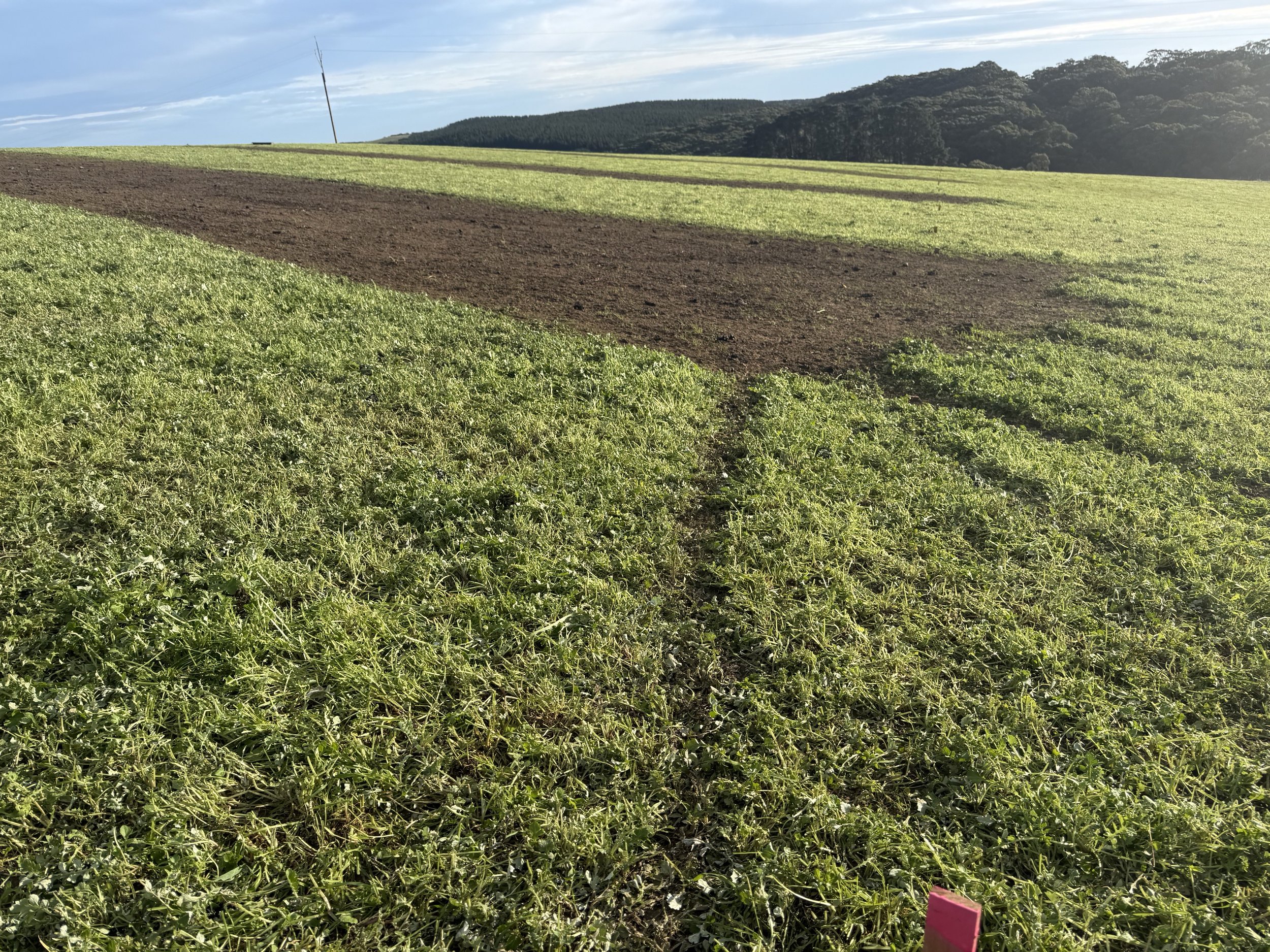
Fleurieu Farming Systems demo block at Parawa is testing the inclusion of a multispecies pasture and the use of aged chicken litter as a soil amendment. The existing ryegrass and clover based pasture acts as the control, and is run per best practice for a high-production paddock for the Parawa region.
Workshops and field days will be announced as we go along, so people can get involved and learn all about what is happening, what we’re finding, how it compares to other sites etc.